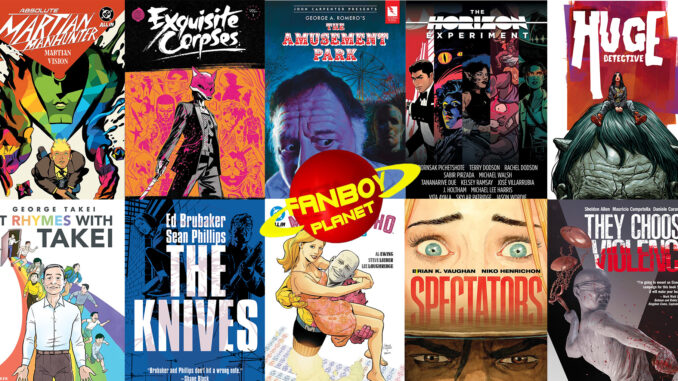
Where did 2025 go? My comics reading stacked up, and at least I was able to do some catching up in the last two weeks of December. The following curated list is not a “Best of…” list, because I know I missed some great books. Hopefully I’ll catch up on some in the next few months, but then I have to start making a list for 2026…
Rules for inclusion:
- Should be reasonably accessible in one volume, either already or about to be when the first arc has finished.
- Unless it’s a standalone graphic novel (still comics), more than 1 or 2 issues had to come out this year. A book can start out strong and falter, so at least 3 issues need to establish this is one to recommend.
- Crossover events are right out. The average reader looking to pick up a good read can be easily drowned in the muck of other continuity.
- A slight cheat here – one book is technically in a larger event, but credit to the publisher for waiting a long long time before characters cross over.
- Any given writer, no matter how good, should only get one slot here because if you like one book by them, chances are you’ll like more and seek them out.
Books are listed in alphabetical order; it’s hard enough narrowing down to 10. If something you loved isn’t here, recommend it to me! Fanboy Planet is an affiliate of both Bookshop.org and Amazon, so purchases made through links on this and other pages may generate a commission for this site. If you would rather support your local comic book store I applaud and encourage that! (Clearly, I’m as bad a businessman as I am a schedule keeper.)
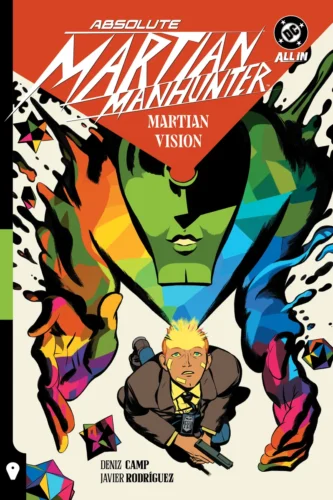 Absolute Martian Manhunter by Deniz Camp and Javier Rodriguez
When a DC hero gets “Absolutized,” it’s expected that a lot of reimagining will happen. That said, Batman, Superman, Wonder Woman, and the Flash still somewhat look like their counterparts in the main DC line. Not the Martian Manhunter.
Deniz Camp and Javier Rodriguez have completely rebuilt the concept from the bottom up. This “martian” isn’t a martian at all. That’s just the concept that Detective John Jones’ limited mind can handle. Merged with this alien consciousness, the detective gets overloaded with mental stimulation, people’s thoughts, concepts, and colors. So many colors.
The alien wants to help inspire humans, fighting against its opposite number, conveniently named a white martian. It’s still green, but a cyclops. Even then, since it comes from another dimension, that may just be how one man perceives it. Because though it can influence, it doesn’t seem to be visible or corporeal to anyone else.
Unlike our better-known J’onn J’onnz, this consciousness has sort of merged with a human. At the end of the first issue, Rodriguez plays with that by drawing two pages that have to be viewed with light behind them to merge into one image. The art stretches the comics form. Others have done so in the past, but it’s cool to see a creative team push the boundaries in what’s meant to be a mainstream book. But then, that’s what DC has been doing in the past year: giving us both things we expect and the absolute unexpected. It’s great.
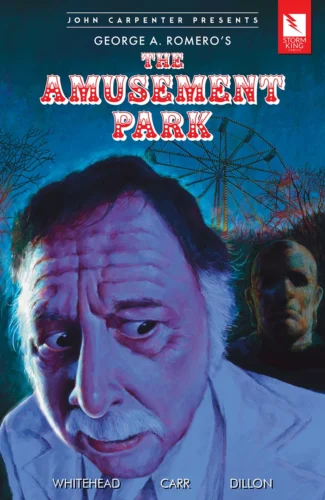 The Amusement Park by Jeff Whitehead and Ryan Carr
Adapting a decades-old movie from a horror master should and shouldn’t work. First, George A. Romero’s film The Amusement Park did not start out as a horror film. The religious group that hired Romero wanted an extended PSA about the trials of being a senior citizen in this country.
If you’re a Gen X-er who has been caring for elderly parents, you know the system hasn’t gotten much better. In fact, it’s downright scary. What Romero delivered was a bit trippy (it was the 1970s), more than a bit metaphorical, and a lot frightening without any gore. Through the director’s eyes, life in these United States is pretty scary.
Whitehead and Carr took that film and provided a slightly different context. Where the movie begins with the main actor identifying himself as an actor, the creative team expands upon a framing sequence, grounding this as more of the surreal nightmare a day in the amusement park becomes.
Imagery from Romero’s better-known films blend into the background, amplifying the unease of the story. Whitehead expands on a few scenes to put into text what the film’s visuals delivered subtextually. It’s necessary for this shift to another medium.
What we end up with is a love letter to a master, published by another master’s imprint, Storm King Comics. Like Romero’s stronger films, it isn’t about what it says it’s about. There’s something to be learned here.
Side note: nice to see that Romero’s daughter has picked up her father’s baton using zombies for social commentary – check out Queens of the Dead on Shudder.
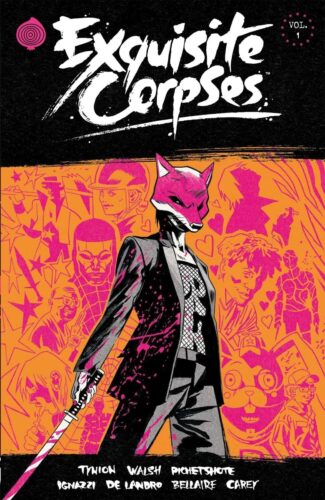 Exquisite Corpses by James Tynion III and a murderer’s row of talent
The name plays with us. As an artistic exercise, “exquisite corpses” means one writer starts a story then passes it along to another without telling them what they had in mind. While this book from Image Comics has many hands behind it, it’s also full of corpses. Not sure if you want to consider them exquisite.
Every five years, America’s wealthiest families gather for a contest. They’ve been doing this since the beginning of U.S. history, and that’s only half of what’s frightening. The game is the worst part.
On Halloween, they isolate a small town from communication and travel. Hey, they’re obscenely rich; that’s not a problem for them. Then each of the 12 families drop a chosen serial killer into the area. They hunt the townspeople and each other. Whichever serial killer remains at dawn determines which family controls the country’s direction for the next 5 years.
Also, it’s like a grotesque game of Clue. Each killer has a hallmark weapon or style, so the outcome depends on which is stronger: subterfuge or chaos.
Image released volume 1 collecting the first 3 issues, fewer than the average trade paperback. But the demand was that strong, and volume 2 will be out shortly. As I slept on the first issue release, I’ve had to go with the trades and am glad I did. Because I’ll be recommending and loaning out this book for a long time.
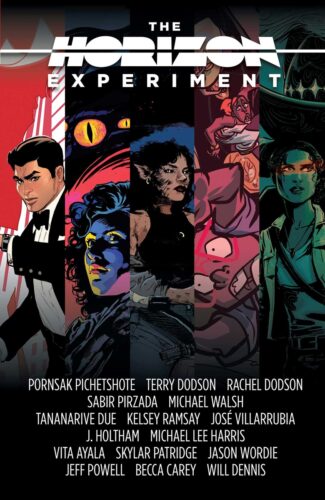 The Horizon Experiment by Pornsak Pichetshote and various
The premise for this anthology is simple. Take a genre or subgenre that usually puts white people at the center of the action and flip the script. Not that being white is bad; we’ve just got plenty of genre fiction telling “our” stories.
Released as a series of one-shots, you may have missed it because each was solicited under its individual title rather than the umbrella. To recap:
The Manchurian by Pornsak Pichetshote, Terry & Rachel Dodson: A James Bond-ish adventure starring a Chinese super spy. Pichetshote sent me down a rabbit hole by telling me he took inspiration from the non-fiction book Tiger Trap. Believe me, that’s an incredible read, too.
The Sacred Damned by Sabir Pirzada: A Muslim exorcist entangled in the mystical; she puts John Constantine to shame.
Moon Dogs by Tananarive Due: Horror master Due focuses on a family of East African lycanthropes crossing paths and claws with another pack in Miami. In the midst of the fight, their secret existence gets exposed.
Motherf#cking Monsters by J. Holtham & Michael Lee Harris: Essentially Evil Dead but instead of Ash, our hero is a nerdy Black kid from Brooklyn. Along with some friends and family, he stumbles across a fraternity trying to raise Hell. While yes, redolent of Raiminess, it’s a blast all its own.
Finders/Keepers by Vita Ayala: I just read a videogame is being developed with a similar concept – it’s an Indiana Jones-like adventure but with an added twist. This grad student steals artifacts from museums and returns them to their cultures.
All 5 are great stories and push our perspectives. If popular demand grows, the experiment will evolve into full-fledged series. I’d like to see them all continue, but if I have to choose one, it’s The Sacred Damned.
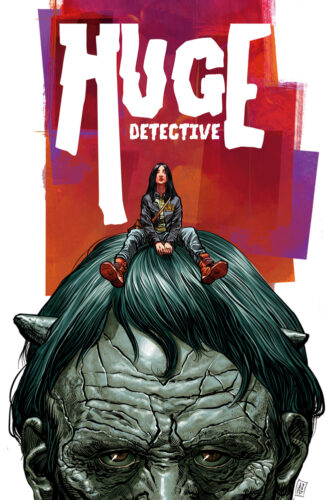 Huge Detective by Adam Rose and Magenta King
I’m cheating here. Huge Detective was on my great comics of 2024 list, too, as 3 of its 5 issues had come out by December last year. For whatever reason, the last 2 saw a delay – and look, with distribution and deals being what they are, the creative team may not have been the cause of said delay.
Or…
It doesn’t matter, because what they owed us was to finish this story on a strong note. Which they did. Huge Detective has murder, mayhem, and mystery, not necessarily in that order. Every chapter peels back another layer on what’s going on and I know I have to read it at least once more to put more of it together in my head.
Rose promised they have another story set in this world, and I can’t wait. It’s got huge possibilities, and I know they’ve figured out so much lore it has to take time to get it out into a strong narrative.
If you haven’t jumped on the shoulders of Huge Detective yet, climb aboard and be ready for whatever Rose and King deliver next.
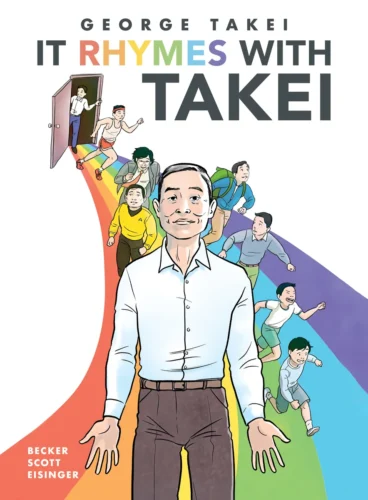 It Rhymes with Takei by George Takei, Steven Scott, Justin Eisinger, and Harmony Becker
History rhymes.
Anyone familiar with the actor/activist knows that his family suffered the indignity of the Japanese internment camps in World War II. Takei covered that part of his autobiography in a stirring graphic memoir, They Called Us Enemy.
In 1995, he covered some of the rest of his life’s journey in To the Stars. But as he admits in It Rhymes with Takei, that book was far from 100% honest about his life, because he couldn’t talk about being gay. Still closeted, he spun a tale closer to his then-public image.
We know that since then, Takei has been public about his sexuality and married to his husband Brad for several years. He has become a role model. Though he must have been working on this before the current administration, he could see the writing on the wall and why his being open and honest was more important than ever.
This time he recounts his college years with candor about his fears and internal struggles. With his creative team, he demurely fades to black before things can get explicit. But that’s because what’s important here is to stand against racism and homophobia. To stand for freedom.
As with Top Shelf Comics’ earlier graphic memoir series March, this isn’t a book to read in one sitting. Because you will be upset and moved knowing this icon had to hide so much of himself for so long. It needed some pauses to digest, knowing that what we’re going through now, he and millions of others went through before.
It Rhymes with Takei isn’t just great; it’s important. Yet it’s also entertaining. You owe it to yourself to read it.
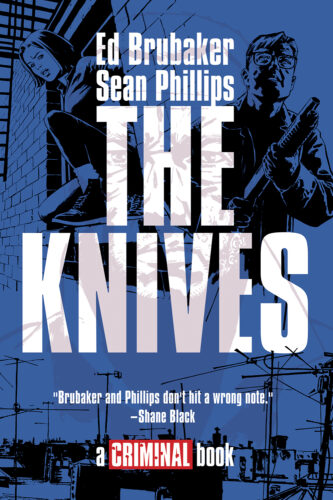 The Knives by Ed Brubaker and Sean Phillips
It’s a gimme that if Brubaker and Phillips release a graphic novel, it’s going to be great. So it is with The Knives.
The latest installment in the loose Criminal world, The Knives ties three storylines tighter and tighter into a braid of desperation, violence, and somehow, hope. Springboarding off of recurring character Jacob Kurtz’ brief adventures in Hollywood, Brubaker and Phillips prove that the boulevard of broken dreams just means you need to find dreams elsewhere.
Eventually we find he’s on his feet back home but being a pseudo-foster father to a cat burglar we’ve met from another storyline. Violence ensues but the worse guys don’t realize that Kurtz has the series protagonist Tracy Lawless on his side.
Though this is late in the series, this graphic novel stands on its own. You might come for the action but get hooked on the characterization.
Brubaker clearly brings some of his own experiences with television development to bear, and writes one of the most incisive things I’ve read about “Hollywood.” Here’s hoping that his current experience developing Criminal into a series for Prime turns out better than things did for Kurtz.
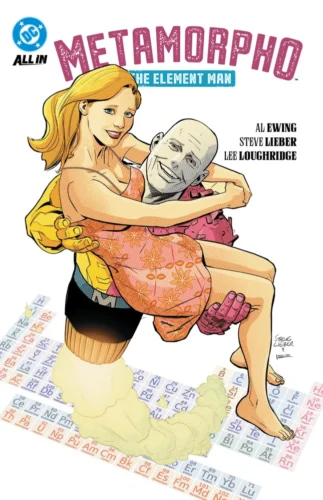 Metamorpho the Element Man by Al Ewing and Steve Lieber
This past summer, movie audiences met Metamorpho in live-action for the first time. Those of us who love weirder heroes have known him our whole lives. Not one of those marquee names, he hasn’t held a solo series for very long. But this 6-issue miniseries proves that you can still go all in on fun.
DC ad copy calls this a “brand-new take” on the Element Man. What makes it work, though, is that Ewing and Lieber have recaptured the feeling of the “checkerboard” era of 1960s DC. For too long, devil may care adventurer Rex Mason has been portrayed as more dour than his origins, when really, he’s surrounded by just enough crazy that he has to laugh.
Ewing captures that rhythm, of a scarred hunk smiling through with swinging ‘60s lingo, though the references are up to date. Somehow Ewing and Lieber bring the Mad Mod into almost making sense in 2025, slightly revamp early Metamorpho enemy The Thunderer, yet the deadly serious Vandal Savage can still be stuck in the middle of the mayhem.
Lieber adapts his style so that occasional panels look like original co-creator Ramona Fradon might have drawn them. He seems to be having a blast bringing in so many characters from the 1960s, from a brief silvery time that comics characters took their adventures seriously, but not themselves.
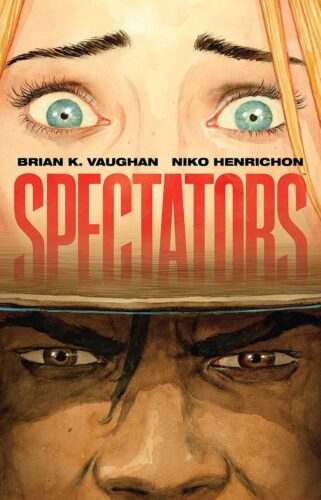 Spectators by Brian K. Vaughan and Niko Henrichon
Not knowing anything going in except Vaughan had written it, Spectators shook me. I was warned by the proprietor of a comics shop not to read it out in public. Yes, it has graphic depictions of sex acts, but that’s the hook for a deeper, darker, disturbing story.
The protagonist dies in a mass murder in a New York movie theater, discovering that the city – and the world – teems with ghosts. Some could pass on to whatever’s next, but most float around and watch. Mostly ghostly peeping toms, some ghosts piece together that something larger has been going on in society to make so many of them.
To say more about the plot would spoil things. Suffice to say that Vaughan and Henrichon have gone for social commentary that’s about more than our own puritanism. That’s not to judge; the shock of the explicitness should not get in the way of the real message here.
Spectators ended up being a graphic novel I couldn’t get out of my head for weeks. It’s not a feel good story, but it is a think hard about it story.
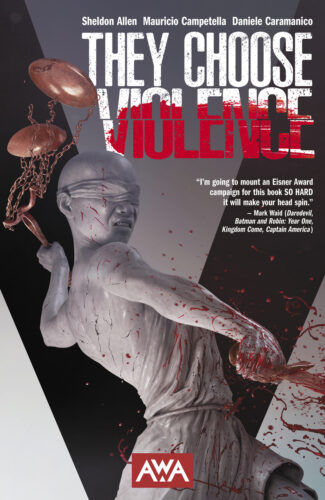 They Choose Violence by Sheldon Allen and Mauricio Campatella
Most of the time, I read comics as an escape. I’m grateful, however, that despite people thinking of comics as a genre, it’s actually a wide range of genres. Notice there’s science fiction, fantasy, crime, horror, memoir, and… this challenge to what you think about how you relate to one of the biggest issues in our country right now.
Three grads from an HBCU stay in touch through their diverse careers. Frustrated by the resurgence of white supremacy, they combine their talents to target high profile supremacists and murder them. Each victim may deserve it, and there’s a catharsis in seeing it play out.
It doesn’t eat at their souls the way some might wish in a story like this. Instead, a copycat killer starts up, targeting high profile black activists. Yet this isn’t a story of cat and mice; it’s about how we relate to race and what the heck are we going to do about it? Murder isn’t the answer, but we have a problem that we as a nation don’t know how to grapple with. Allen and Campatella aren’t going to give us the easy answer we think the story might be heading toward.
Like Spectators, this one stuck with me. Unlike Spectators, I followed this book in monthly issues from AWA Publishing and each issue had me on the edge of my seat – or the edge of my bed, as I was foolishly thinking “I’ll read a few comics before I go to sleep…”
Honorable Mention:
The Free Speech Handbook. If you haven’t picked this up, you need to. It’s not a balm, but it does make some things about our current discourse a little understandable.
Reminder: Fanboy Planet is an affiliate of Bookshop.org and Amazon. All links on this page are to Bookshop.org. Purchases made through links on this and other pages may generate a commission for this site.