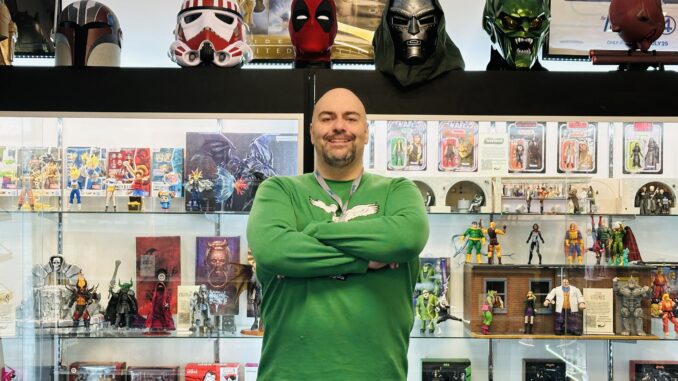
Howdy Planeteers! Today in the Pulp Arcana Studios corner of Fanboy Planet, we have something special for you. As people are reaching out and asking how they might get started with collecting some of the figures we review here, I wanted not only recommend a great place to shop online, but see if we could go further. I thought it might be fun to try and take a peek behind the curtain, and see what it’s like to run an online toy store.
And this is where Matt “Big Nerdy” Roberts from Nerdzoic came to the rescue. For those in the know, Nerdzoic is one of the best online sources to find all kinds of action figures. Great service, great experiences. When I did my Best Desk Figures article for the holidays, a number of the links I put in were to Nerzoic.com But what sets Nerdzoic apart from the competition is the personal touch. Nedzoic is a family business, run by a fan, and it shows in every interaction I have ever had with the company. So when I knew I wanted to do a piece like this, Nerdzoic was the first place I hit up. And because Big Nerdy is the absolute best, he delivered the goods.
I wanted to take readers behind the scenes of an online toy retailer. But what I got in this interview was so much more. I got the story of a man and his family and the store they built from the ground up, and more insider information than I could have ever hoped for. So come with me, Planeteers, and meet my friend Matt Roberts, and let Big Nerdy give you a taste of the business side of toy collecting.
SECTION A — ORIGIN STORY
“You launched Nerdzoic in 2020, which was a chaotic time globally. What made you decide that was the moment to jump in?”
I decided it was a good time just kind of happenstance. I had no intention of Nerdzoic becoming what it is. It was really meant to get my feet wet in video marketing, which I thought was something I could make real money in doing something else, specifically restaurant-related.
Toys were just something that I liked, so it was a great way for me to have something “easy” to talk about, something I enjoyed while I learned the production process. I did treat it like a business from the beginning. I’m kind of bleeding into number two here, just because that’s how I always felt like it should be and would be.
I just never expected it to go very far. I remember specifically saying to Anna at one point that we’d be lucky if this end of the business, even if it blew up, ever generated more than $1,500 in profit a month. So I never really had high expectations.
“At what point did it stop being ‘a side passion’ and start feeling like a real business?”
It was pretty much a business from day one. I didn’t really feel like it was a business, though, until it became my full-time job in 2023. Before that, it just felt like a side project.
“What early lesson did you learn that still shapes how you run Nerdzoic today?”
That’s a tough one.
I think the number one lesson is probably this: have no expectations of anybody or anything else and expect to have to work and grind for everything you want. There is no manual. There’s no book. There’s no way to simply learn how to do it. You have to teach yourself.
The hard part of teaching yourself is you don’t know what you’re going to need to teach yourself. So you have to train yourself to figure out what you need to learn. That’s probably the biggest thing I figured out early.
There was no other resource. There was no “go to my boss.” There was no corporate. There was no training department. It was, “Okay, I need to figure this out myself.” That meant doing the research and almost treating it like being a journalist.
SECTION B — RETAILER INSIGHT
“From your perspective, what do collectors misunderstand about running a toy retail business?”
I think the thing people most misunderstand is anything regarding profit and sales, especially when it comes to what people call “scalpers.”
I purposely built our brand to focus on volume and making money through volume, not through individual high-margin sales. That’s the business model I gravitate toward. In restaurants, I always preferred to work in the busiest stores.
What people misunderstand is pricing. A lot of the time they’ll see a store price something higher than MSRP and immediately call them scalpers and greedy. But what they’re missing is they don’t complain when something is sold under MSRP.
At the end of the day, the store needs to balance its profit margin. Let’s say your goal margin is around 30%. Some brands operate below that, so you have to balance your mix of products to make the business work.
What really hurts—especially smaller stores—is when you have to sell something at a huge discount or liquidate. You have to make that money up somewhere. That’s often why prices go higher elsewhere.
So far, we’ve avoided that for the most part through smart purchasing decisions. But it’s something people get wrong a lot.
“What separates a retailer that lasts from one that burns out?”
Probably grit more than anything else. Getting up every day and doing the hard work and realizing it doesn’t get easier. That’s not just being a retailer—that’s being a business owner.
It’s not “I’m an owner now, I don’t have to work, I get to sit on the beach.” That’s what get-rich-quick schemes sell you.
The reality is you’re going to continue to work hard. In order not to burn out, you have to understand that, take time off when you need it, and have the right mindset going in. There are going to be hits and misses. You have to roll with the punches.
If your personality doesn’t naturally match the expectations of the job, you have to find a way to balance that or you’re in the wrong business.
A great example: “I was talking to someone today about placing large advance orders on products that haven’t even been announced yet.. They asked how that doesn’t drive my anxiety crazy.
It used to. But I had to change my mindset. One, those numbers can often be adjusted. Two, worst-case scenario, I close it out quickly because I bought the wrong thing. That’s not the end of the world.
“How do you decide which lines to invest in and which to pass on?”
The number one thing that gets you in the door is margin.
If I look at a toy line and the profit I’m going to make is less than my bulk clients like Hasbro or Mattel, that’s usually an immediate no. With those companies, the margins are lower, but you sell so much volume that you make your money.
Sometimes someone will say, “Here’s what you’ll make per unit,” and it’s less than that. Best-case scenario, you become the next Hasbro. What are the odds of that? Slim to none.
Next is the person behind the product. How do I view them as a business person? Do I think they’re a stand-up person? Do they have solid business fundamentals? Do they have good decision-making skills? Is their cash flow sound?
If I don’t think their business is fundamentally sound, I won’t invest in it.
Once they pass those two filters—margin and business stability—then I look at the product itself. But to even get there, they have to pass the first two.
SECTION C — CREATOR & COMMUNITY
“You’ve supported podcasts, YouTube channels, and creators. What makes a creator partnership feel worthwhile from your side?”
When I started, there were creators who wouldn’t give me the time of day. They wouldn’t respond or acknowledge me. I understand keeping up is hard, but I told myself that if I ever got anywhere, I wanted to support smaller creators.
So if someone asks me to be on a podcast or collaborate and all I have to do is show up and it’s not a huge time commitment, my answer is almost automatically yes—unless there’s something disqualifying about their content.
Before the toy store, I wasn’t very picky. Now, I look more for political neutralness. It’s such a divided environment. I don’t want to align the business with anything political.
“What kind of content genuinely helps a retailer? What is not just noise, but genuinely useful?”
For us, it’s a little different because most people I’ve worked with started with a smaller presence than Nerdzoic on YouTube.
It helps if someone has a presence in something we don’t. For example, if it’s anime and we haven’t made anime content, an anime creator saying, “This is a good retailer, they’re trustworthy,” that helps.
But really it comes down to testimonials—about the right things.
I don’t need someone saying Nerdzoic has the best prices. I don’t want to fight to be the lowest price. That’s how stores go out of business.
I like hearing that Nerdzoic has the best service. I ask a question and get an answer. They’re consistent. Everything comes packaged properly and on time.
We’ve been using the phrase “small enough to care, big enough to get the job done.” That’s what I want us to be. Mom-and-pop feel, but big enough to offer near-MSRP pricing and real accessibility.
The most useful content is organic. Not ads. You won’t see me paying for traditional sponsor shoutouts like, “Before we start, thanks to our sponsor.”
It’s much more useful when someone says, “I picked this up from Nerdzoic. It shipped super fast.” That’s authentic.
Honesty and transparency represent us best.
SECTION D — FUTURE THINKING
“You’ve recently opened a brick-and-mortar store. Have you been planning this for a while? Where do you see Nerdzoic in five years?”
Yes and no.
It’s been an idea for a long time. But I think some people might be disappointed because it’s not a traditional brick-and-mortar.
That model doesn’t scale well. You need space, staff, overhead. That forces higher prices, which goes against our volume model.
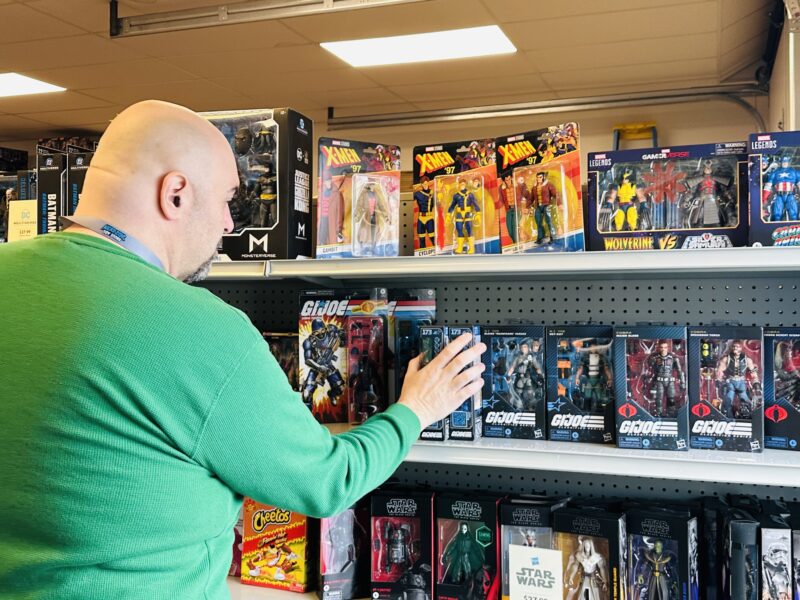
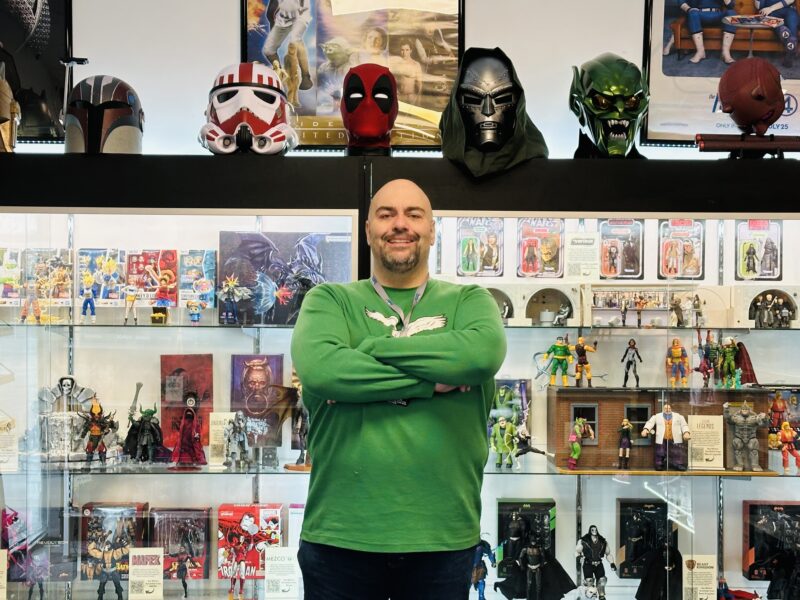
So I wanted more of a showroom than a retail store. There’s very little product physically out. I don’t rotate it constantly because that’s overhead.
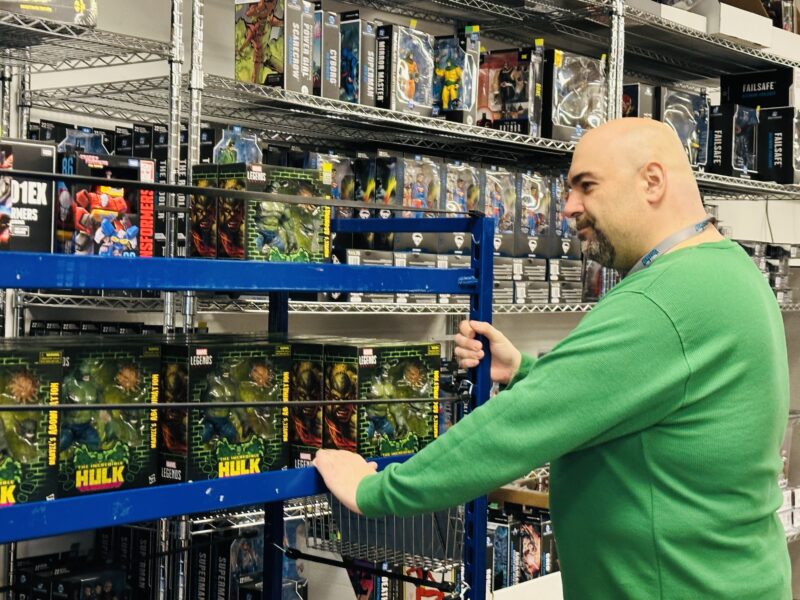
Instead, we have a kiosk where you can shop what’s in the warehouse. We bring it up front for you. I think that’s a more modern approach.
In-store customers buy different things than online customers. TCGs like Magic, Pokémon, and Riftbound sell better in person. We just added Warhammer and I expect that to be mostly in-store.
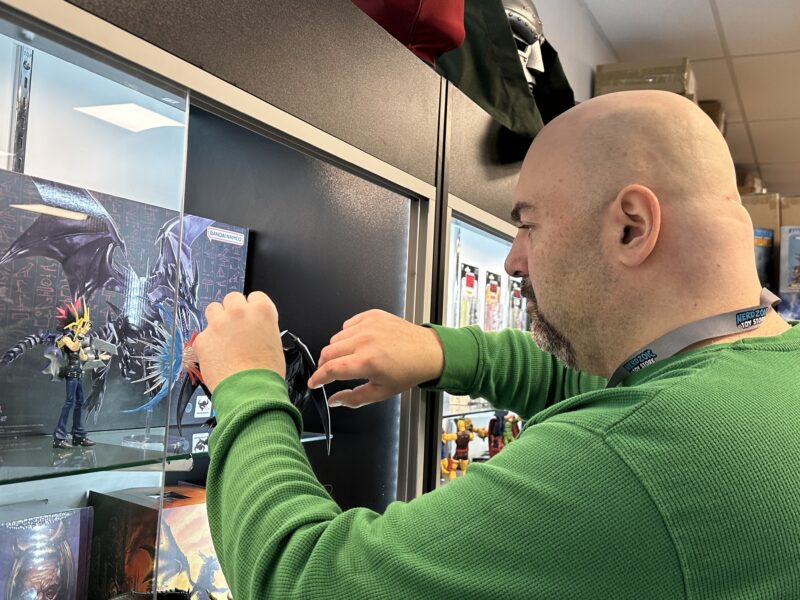
I also want to use the space for display cases, dioramas, and scenes so people can see what the hobby can be beyond just keeping things in the box.
“Is there something you’d love to build into the business that you haven’t yet?”
That’s a long list.
I want to buy and resell used products at scale with streamlined listings. For example, one listing for a figure with condition options instead of separate listings every time.
I want to build a portal where people can see what I’ll give them in trade versus cash.
I’d like to expand into trading cards more and maybe even sports cards.
I want to return to more media—podcasts and YouTube. I haven’t done much of that in a year.
I’d like to upgrade the website’s browsing functionality so people can discover things they didn’t know they wanted or find exactly what they’re looking for quickly.
I’d love to host conventions one or two times a year.
Outside of Nerdzoic, I’d like to start a second company focused on helping people transition from corporate jobs into entrepreneurship—not teaching them to open toy stores, but helping them identify their transferable skills and plan responsibly instead of burning the boat.
“If a new collector walked into the hobby today, what advice would you give them?”
Don’t buy everything. Set a budget.
Don’t compare yourself to YouTubers who show massive hauls. Some are wealthy. Some buy, open, and resell to fund their content.
If you’re collecting for yourself, figure out what you like. Buy a few things first. Sell what you don’t love. Then go deeper into what you truly enjoy.
Find a community you like. Find a line with longevity so it continues to produce new releases.
So there you have it Planeteers. Big Nerdy opened the door and took us inside. A huge thanks to Matt for this interview, and his wife Anna, who was kind enough to provide the photos used in this article.
Filed by Mark Gelineau of Pulp Arcana Studios for Fanboy Planet
Ever since the day he discovered his grandfather's stack of pulps, comics, and sci-fi and fantasy novels, Mark has been hooked. An author, educator, and toy photographer, Mark's photography work can be found on Instagram at @pulp_arcana_studios
Websites store cookies to enhance functionality and personalise your experience. You can manage your preferences, but blocking some cookies may impact site performance and services.
Essential cookies enable basic functions and are necessary for the proper function of the website.
Name
Description
Duration
Cookie Preferences
This cookie is used to store the user's cookie consent preferences.
30 days
These cookies are needed for adding comments on this website.
Name
Description
Duration
comment_author
Used to track the user across multiple sessions.
Session
comment_author_email
Used to track the user across multiple sessions.
Session
comment_author_url
Used to track the user across multiple sessions.
Session
Statistics cookies collect information anonymously. This information helps us understand how visitors use our website.
Google Analytics is a powerful tool that tracks and analyzes website traffic for informed marketing decisions.
Contains information related to marketing campaigns of the user. These are shared with Google AdWords / Google Ads when the Google Ads and Google Analytics accounts are linked together.
90 days
__utma
ID used to identify users and sessions
2 years after last activity
__utmt
Used to monitor number of Google Analytics server requests
10 minutes
__utmb
Used to distinguish new sessions and visits. This cookie is set when the GA.js javascript library is loaded and there is no existing __utmb cookie. The cookie is updated every time data is sent to the Google Analytics server.
30 minutes after last activity
__utmc
Used only with old Urchin versions of Google Analytics and not with GA.js. Was used to distinguish between new sessions and visits at the end of a session.
End of session (browser)
__utmz
Contains information about the traffic source or campaign that directed user to the website. The cookie is set when the GA.js javascript is loaded and updated when data is sent to the Google Anaytics server
6 months after last activity
__utmv
Contains custom information set by the web developer via the _setCustomVar method in Google Analytics. This cookie is updated every time new data is sent to the Google Analytics server.
2 years after last activity
__utmx
Used to determine whether a user is included in an A / B or Multivariate test.
18 months
_ga
ID used to identify users
2 years
_gali
Used by Google Analytics to determine which links on a page are being clicked
30 seconds
_ga_
ID used to identify users
2 years
_gid
ID used to identify users for 24 hours after last activity
24 hours
_gat
Used to monitor number of Google Analytics server requests when using Google Tag Manager